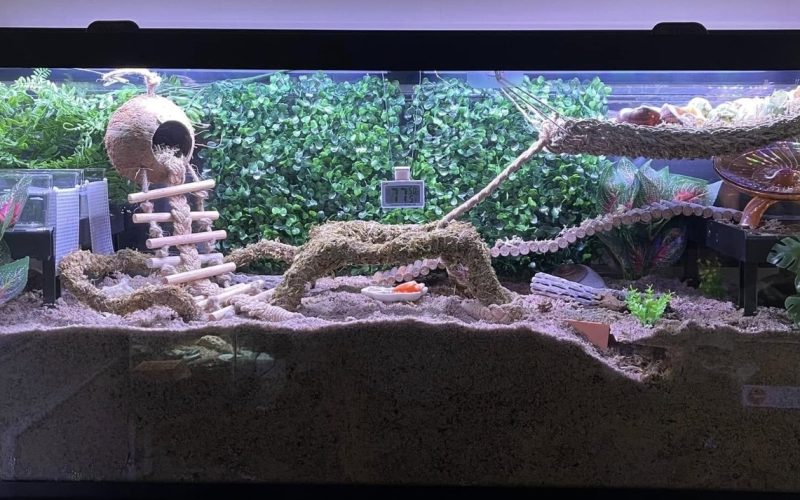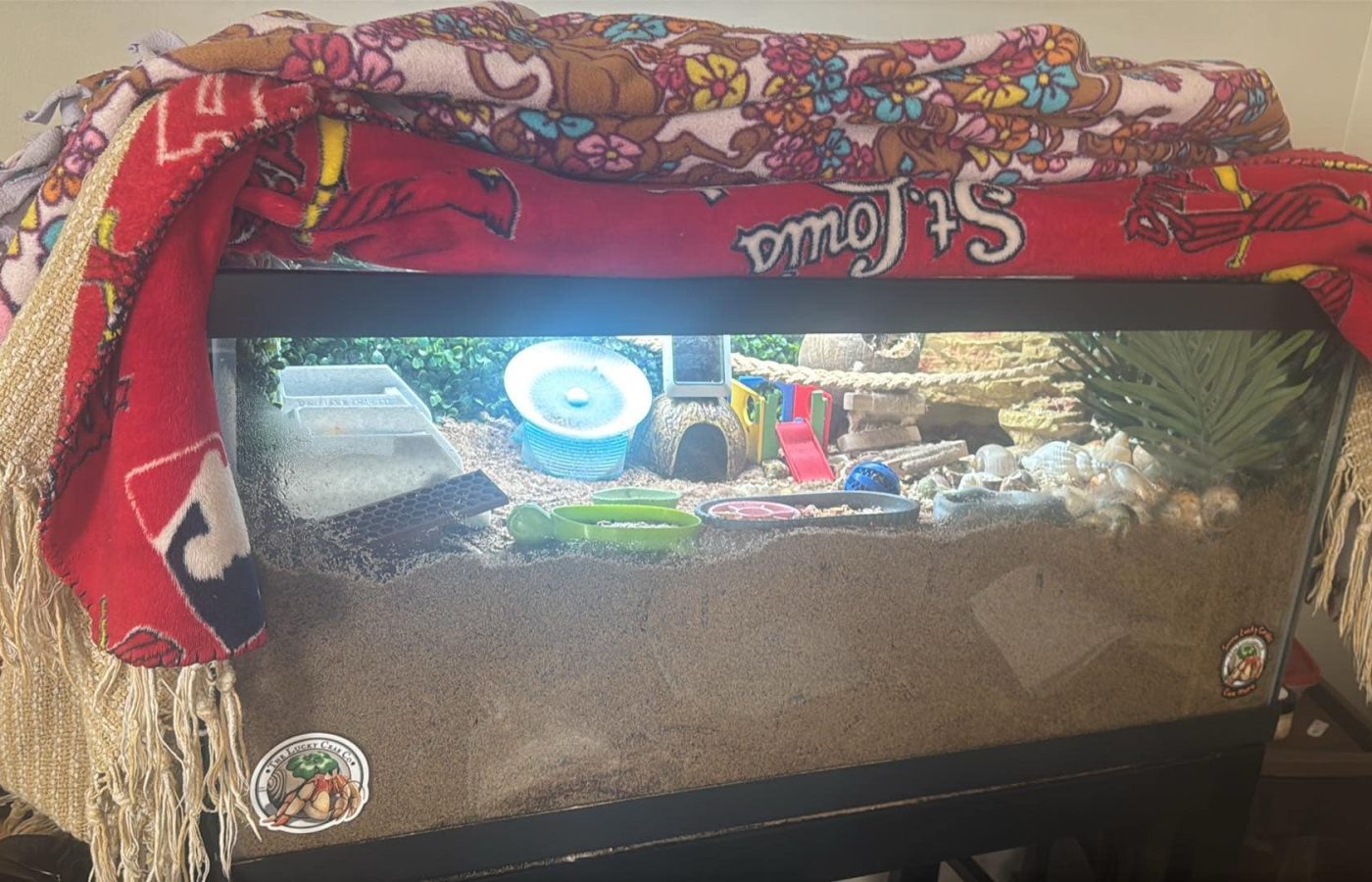
A good land hermit crab habitat has enough floor space and deep substrate for molting, separate freshwater and saltwater pools, reliable heat and humidity, plenty of natural shells, varied food, and a normal day/night cycle. This guide generally focuses on Purple Pinchers (Coenobita clypeatus); other species can need different care.
The essentials checklist
The Start Here page has the full linked checklist. The sections below give the supporting detail from the New Owner FAQ.
What size tank do I need?
Plan for at least 10 gallons per small-to-medium crab, with substantially more room as crabs grow — this is the Land Hermit Crab Owners Society’s minimum, and it works as a practical planning figure for a beginner buying a tank. What matters is usable space, not just volume: enough floor area and substrate depth for crabs to molt away from each other, plus room for pools, shells, hides, and climbing. Small plastic carriers and wire cages are not acceptable homes.
Source note: the three references frame it differently — HCA’s care sheet gives a 10-gallon floor for small crabs and roughly 5 gallons per crab for long-term housing of small crabs (with 75+ gallons for a fully grown one); CSJ calls a 10-gallon tank suitable only for two very small crabs and suggests 29 gallons as a more practical starting point. Sources differ; no single number is asserted as universal, and the FAQ leads with LHCOS’s explicit per-crab minimum.
Sources: LHCOS Habitat Standards (https://lhcos.org/hermit-crab-care-education-standards/habitat-standards-for-ethical-hermit-crab-care/); HCA Basic Care Sheet (https://hermitcrabassociation.com/phpBB/viewtopic.php?f=51&t=92457); CSJ new-owner checklist (https://crabstreetjournal.org/blog/the-newbies-guide-to-hermit-crabs/)
What goes on the bottom of the tank?
A mix of children’s play sand and coconut fiber (sold as Eco Earth or coco fiber), roughly five parts sand to one part fiber. Dampen the mix until a squeezed handful holds its shape like a sandcastle — firm enough to tunnel in without collapsing, not dripping wet. Make it at least 6 inches deep, or about three times the height of your largest crab, whichever is deeper.
Shallow substrate is inadequate and must be corrected. Note, though, that a surface molt by itself does not prove the setup is bad — current CSJ guidance says surface molts can occur in otherwise stable, suitable habitats. The real hazard is that a soft crab is vulnerable to interference and injury from tankmates, so protect it (see Q11).
Sources: HCA substrate guide (https://hermitcrabassociation.com/phpBB/viewtopic.php?p=852645); CSJ surface-molt guide (https://crabstreetjournal.org/blog/surface-molts/) — accessed 2026-10-04
What temperature and humidity do they need?
For Purple Pinchers: 75–85 °F, with about 80 °F as the sweet spot. Below roughly 70 °F for extended periods, crabs go dormant and can die. Humidity: 70–85% is the commonly cited band; note that HCA’s Purple Pincher sheet caps its recommendation at 80% because higher humidity encourages mold (it also says higher is safe for the crabs). Hermit crabs breathe through modified gills, so humid air matters as much as warmth.
Sources: HCA Basic Care Sheet (https://hermitcrabassociation.com/phpBB/viewtopic.php?f=51&t=92457); HCA Purple Pincher species sheet (https://hermitcrabassociation.com/phpBB/viewtopic.php?t=92452); LHCOS Habitat Standards (https://lhcos.org/hermit-crab-care-education-standards/habitat-standards-for-ethical-hermit-crab-care/)
My humidity is high but my temperature is low. What do I do?
Two different problems, two different responses — don’t mix them up.
Cold tank (temperature too low): fix the temperature first. Warming the air doesn’t magically raise relative humidity — at the same moisture level, warmer air actually reads lower on the humidity gauge. What heat does is drive more evaporation from the pools and damp substrate, putting more moisture into the air. Mount the heat mat on the back or side wall, never underneath — buried crabs can be cooked. Check your mat maker’s instructions for how high the mat should sit relative to the substrate line (Ultratherm pad guidance from The Bean Farm — a seller’s product page, model-specific seller guidance, not a universal manufacturer manual — advises keeping the pad mostly above the substrate line). Control the heat with a thermostat — a dimmer only reduces power and doesn’t respond to temperature, so it is not equivalent to thermostat control; place the probe per the controller’s instructions and confirm it is compatible with your mat. On insulation: actual mat and controller manuals govern compatibility, mounting, probe placement, and insulation — some manufacturers prohibit covering their pads, while others allow insulating around certain models; follow your own product’s instructions, and never insulate in any way the manufacturer prohibits.
Too much moisture (constant saturation, heavy condensation, flooding): this is not a “raise the humidity” situation — adding moisture makes it worse. Cut back on misting, make sure the lid seals properly with small vents for airflow (not airtight), and slightly increase ventilation. Do not add large water bowls or damp moss to fix excess moisture; those are humidity-raising measures for the opposite problem.
Sources: CSJ new-owner checklist (https://crabstreetjournal.org/blog/the-newbies-guide-to-hermit-crabs/) — accessed 2026-10-03; HCA Basic Care Sheet (https://hermitcrabassociation.com/phpBB/viewtopic.php?f=51&t=92457) — accessed 2026-10-03; Ultratherm pad guidance (https://beanfarm.com/products/ultratherm-heat-pads-6-x-17-in) — accessed 2026-10-04; HCA forum admin threads on insulation — accessed 2026-10-03
What kind of shells do they need?
Natural, unpainted turbo-style shells. Keep at least 3 to 5 spare shells per crab — include shells in the crab’s current size as well as modestly larger options, and let the crabs choose. A commonly used fit reference is a shell opening roughly the size of the crab’s large pincer, but that rule isn’t universal — crabs regularly pick shells that look too big or too small to you, so verify opening measurements, shape, weight, and your species’ preferences when buying (Etsy-style sellers that list exact opening measurements help). For Purple Pinchers, tapestry turbos and striped/Mexican/grey turbos are preferred types. Keep painted, glazed, dyed, or coated shells out of the tank — keepers avoid them because of toxic-paint concerns, though that avoidance advice is keeper caution, not a demonstrated chemical analysis. Shell shortage is serious: a crab short on options may force a tankmate out of its shell and steal it.
Sources: HCA Basic Care Sheet (https://hermitcrabassociation.com/phpBB/viewtopic.php?f=51&t=92457); HCA Purple Pincher species sheet (https://hermitcrabassociation.com/phpBB/viewtopic.php?t=92452)
Where can I buy good shells, and how do I prepare them?
Natural shells are sold online and in craft stores; several keepers buy from Etsy sellers that list exact opening measurements. Choose by species suitability and measured opening size rather than a marketplace name alone. Before offering new shells, clean and prepare them using a verified method: boiling heat-safe empty shells in dechlorinated water for about five minutes is one such method — boiling is preparation, not proof of complete sterilization. Soak and carefully check each shell first to make sure no crab is hiding inside, and never boil an occupied shell; soaking alone doesn’t prove a shell is empty, so inspect it. Emergency rinsing (a quick rinse with conditioned freshwater when you need shells immediately) is separate from routine preparation.
Sources: HCA Basic Care Sheet (https://hermitcrabassociation.com/phpBB/viewtopic.php?f=51&t=92457); CSJ tank-cleaning guide (https://crabstreetjournal.org/blog/how-do-i-clean-my-hermit-crab-tank-crabitat/) — accessed 2026-10-04
What do I feed them?
Think varied scavenger diet: fruit and protein (meat, insects, seafood) daily, plus vegetables and plant matter, with calcium (cuttlebone, crushed coral, eggshell) available at all times. Swap out fresh food every day so it doesn’t mold in the warm, humid tank.
On commercial hermit crab foods: both major references lean against making pellets the foundation of the diet. HCA and CSJ note that ethoxyquin and copper sulfate appear on many pellet ingredient lists and advise against pellet-centered diets. That is keeper caution about what the ingredient lists show — not product-specific evidence about any particular product’s dose or exposure — so assess products by their own ingredient lists, and keep the diet varied rather than pellet-centered.
Sources: HCA Basic Care Sheet (https://hermitcrabassociation.com/phpBB/viewtopic.php?f=51&t=92457); CSJ food guide (https://crabstreetjournal.org/blog/hermit-crab-food-guide/)
Do they need both fresh water and salt water?
Yes — two separate pools: one freshwater, one saltwater made with marine aquarium salt (such as Instant Ocean). Table salt and freshwater-aquarium salt are not substitutes. Condition your tap water according to the product’s own instructions — conditioning products differ, and a product that dechlorinates does not necessarily remove heavy metals, while others bind or detoxify specified contaminants. Treat for chlorine/chloramine as applicable and follow the label.
Mix marine salt per the product’s own package instructions. Instant Ocean’s own product page says to mix with ordinary dechlorinated tap or purified water — ½ cup per US gallon for small quantities — stir vigorously, aerate, then measure the specific gravity (recommended range 1.020–1.024 at 77 °F), adding salt or dechlorinated water to adjust. Instant Ocean’s own usage note: never mix salt in an aquarium containing animals — mix outside occupied pools, and only return animals after the salt is completely mixed, aerated, and adjusted. These figures are the product’s mixing recipe, not species-specific evidence of optimal salinity for Purple Pinchers.
Each pool should be deep enough for your largest crab to fully submerge, and every pool needs something the crabs can climb to get back out — a crab trapped underwater can drown.
Sources: HCA Basic Care Sheet (https://hermitcrabassociation.com/phpBB/viewtopic.php?f=51&t=92457); LHCOS Habitat Standards (https://lhcos.org/hermit-crab-care-education-standards/habitat-standards-for-ethical-hermit-crab-care/); CSJ new-owner checklist (https://crabstreetjournal.org/blog/the-newbies-guide-to-hermit-crabs/); Instant Ocean Sea Salt product page (https://www.instantocean.com/products/sea-salt-mixes/sea-salt) — read directly 2026-10-04
What wood and decorations are safe?
Standard safe climbing woods include cholla wood, cork bark, mopani, and driftwood; keeper moderators also list oak, aspen, and pinecones. Yard-collected wood needs positive identification of the species plus a safe-material reference before it goes in the tank — “pesticide-free” alone does not make every yard wood safe. “Driftwood” describes where a piece came from, not a safety guarantee: unknown coatings, treatments, contamination, and decay still matter. If you’re not sure what a wood is, keep it out of a beginner tank. Avoid cedar — its oils are harmful to hermit crabs — and steer clear of pine branches and large amounts of pine (strong volatile oils), plus anything painted, dyed, or pressure-treated. Boiling or baking does not make an unsafe wood safe — heat treatment is for killing hitchhikers, bacteria, and mold on materials that are already safe, not for detoxifying toxic ones.
Sources: HCA Basic Care Sheet (https://hermitcrabassociation.com/phpBB/viewtopic.php?f=51&t=92457); CSJ tank-cleaning guide (https://crabstreetjournal.org/blog/how-do-i-clean-my-hermit-crab-tank-crabitat/) — accessed 2026-10-04; HCA wood thread (https://www.hermitcrabassociation.com/phpBB/viewtopic.php?t=109532)
Do I need special lighting?
Give them a steady day/night rhythm — about 12 hours of light and 12 of dark — with true darkness at night. A conservative beginner setup: ambient room light in a bright room, or a simple low-heat light on a timer in a dark corner. Keep direct sunlight off the tank (overheating risk). If you use any night lighting, remember that colored bulbs are still light, not darkness — the dark period should be truly dark. UVB light has not been shown necessary for Coenobita calcium metabolism, molting, or survival — phrase that as a lack of established necessity, not proof it has no benefit; don’t treat UVB as a beginner requirement.
Heat-lamp recommendations differ among keeper references. For this beginner guide, use the wall-heater approach described in Q5 and follow the actual product instructions; this does not establish that every other heating system is unsuitable.
Sources: CSJ new-owner checklist (https://crabstreetjournal.org/blog/the-newbies-guide-to-hermit-crabs/); CSJ UVB article (https://crabstreetjournal.org/blog/is-uv-light-necessary-for-land-hermit-crabs/).
For measuring the sand-to-fiber ratio, see Q3 in the FAQ.
Editorial source review: October 4, 2026. This is an editorial draft of keeper guidance, not veterinary approval. Guidance generally focuses on Purple Pinchers (Coenobita clypeatus).